In development  ·  playable internal build, November 2026

Learn a language by
surviving the conversation.

WMSOFT Lab is building a language learning game you play by talking. Each day is a story mission: an AI character sets the scene, you answer out loud, and your sentence is transcribed and judged on the spot. Afterwards a tutor checks what you said against the target expression word by word — and between missions, you can send the character a photo and keep the conversation going.

iOS · Android · web companion planned Voice-first · speak, then fix Built in the Republic of Korea
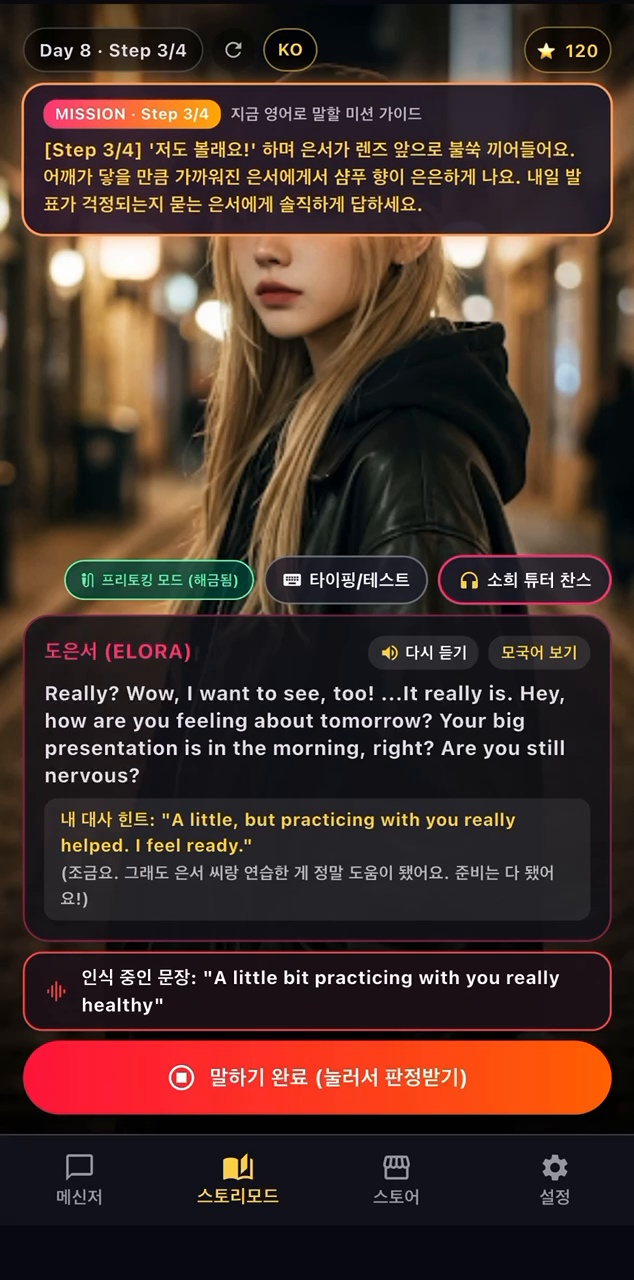
Actual build Story mode in the WMSOFT Lab language app: Day 8, Step 3 of 4, a mission from the AI character Elora, the sentence being recognised while the learner speaks, and one button to finish speaking and be judged.
Story mission, Day 8 · Step 3/4 — the app shows the sentence it hears while you are still speaking.
Already running in the build
  • Story-mode missions
  • Live speech recognition
  • Word-by-word tutor review
  • Photo-aware chat
In-development build

In-Development Mobile App Preview

These are not mockups. Every screen below is a capture from the build we are testing right now, on a phone, with the interface in Korean and English as the language being learned. Three of the app's screens, in order of how a learner meets them.

Story mode screen: Day 8, Step 3/4 mission from the AI character Elora, the sentence being recognised as speech, and a button to finish speaking and be judged.
01 · STORY MODE

Story missions you answer with your voice

Day 8, Step 3 of 4. The character — Elora in this build — sets a mission inside the scene, and the app shows the sentence it is hearing as you speak it. One tap finishes the turn and sends it to be judged; clearing the step unlocks free talking with the same character.

Day & step progressLive transcriptPoints · 120Free-talk unlock
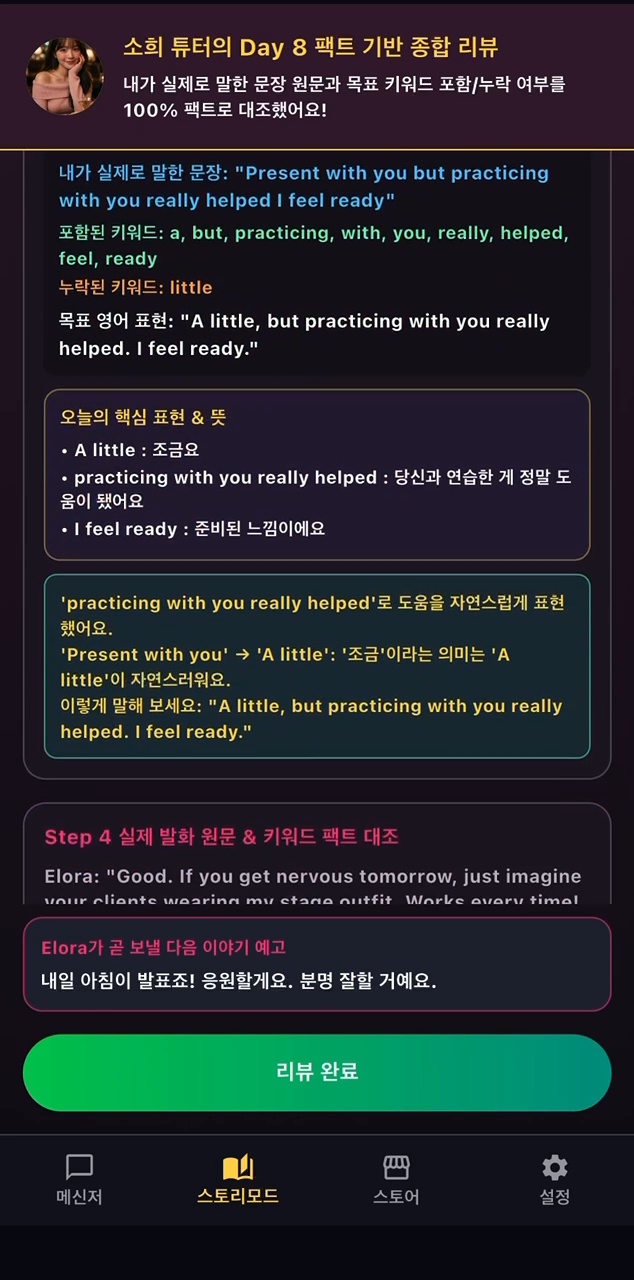
Tutor review screen comparing the learner's spoken sentence with the target expression, listing the keywords that were included and the one that was missed.
02 · TUTOR REVIEW

A review that is checked, not guessed

The sentence the learner actually said is placed next to the target expression and compared word by word: the keywords that were used, and the one that was dropped. The review then lists the day's key expressions with meanings, explains what read as unnatural, and quotes what the character says next.

Included / missing keywordsKey expressionsCorrection notes
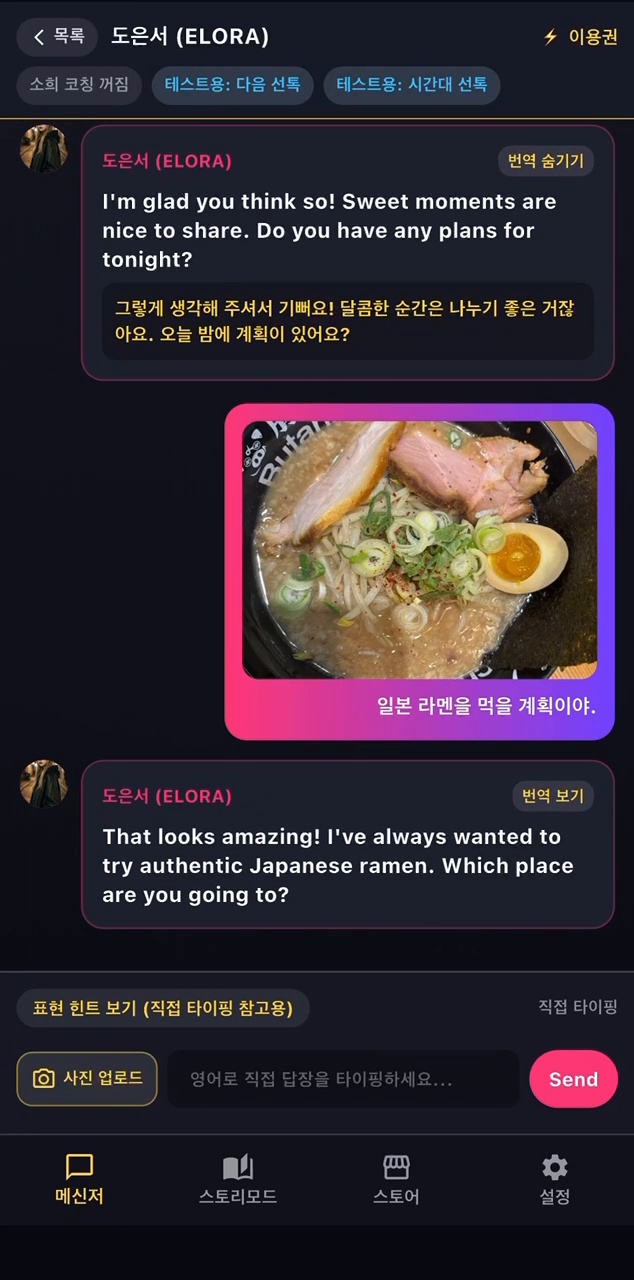
Messenger screen: the learner sends a photo of a bowl of ramen, and the AI character answers in context, with a translation toggle and an expression-hint button.
03 · MESSENGER

Chat that understands a photo

Between missions the character is still there to talk to. Send a picture and it reads the image — here a bowl of ramen — so the reply follows the conversation instead of asking what was sent. Every line carries a translation toggle, expression hints are one tap away, and replies can be typed directly.

Photo uploadImage understandingTranslation toggleHints
Core capabilities

Four things the build already does.

Not a feature list written for a pitch: each of these is a system the learner touches in the screens above. Speaking is the input everywhere, and what comes back is specific enough to act on in the next sentence.

01 · Story mode

Story Missions, Spoken Out Loud

A day is a story arc and a step is a scene: the character has a situation, a mood and something it wants from the learner, and it answers what was actually said rather than running a script. The mission is stated before speaking, the sentence being recognised is shown live, and one button ends the turn and sends it to be judged. Clear the step and free talking with that character opens up, with points for each step.

02 · Tutor review

Fact-Based Tutor Review

After the mission, the tutor puts the learner's own sentence next to the target expression and compares them word for word: which keywords were included, which one was missed, no model opinion in between. It then lists the key expressions of the day with meanings, explains why a phrasing read as unnatural and what to say instead, and shows what the character says next with its meaning — so the correction belongs to the conversation that just happened.

03 · Messenger

Multimodal Photo Messenger

The conversation does not stop when the lesson does. In the messenger the learner can send a photo, and the app understands what is in it: a picture of a bowl of ramen gets an answer about ramen, in English, in the character's voice. A translation toggle sits on every line, expression hints are available for direct typing, and photos can be sent instead of a sentence — which is how real messaging already works.

04 · Progression

Days, Steps, Points and Unlocks

Progress is visible on every screen: the day and step being played, points earned, and the next mode waiting behind a cleared step. Because a step can be failed and retried, the game keeps the learner in the scene until the mission is actually done, and the unlocked free-talk mode turns the same character into somewhere to practise without a target.

How a session runs

Talk, get judged, keep talking.

01

Open the day and step

The story resumes where it stopped — Day 8, Step 3/4. The mission is spelled out in the learner's own language before anything is spoken.

02

Speak the answer

The character speaks in character. As the learner answers, the recognised sentence appears on screen, so a misheard word is visible before the turn is sent.

03

Get judged, then reviewed

The turn is scored on the spot. The tutor review then sets the sentence beside the target and shows the keywords used, the one missed, and how the problem phrase should sound.

04

Stay in the conversation

A cleared step unlocks free talking. In the messenger the learner keeps chatting, sends photos, toggles translations and pulls up expression hints.

Under the hood

An audio pipeline built for conversation, not for one-shot queries.

Talking to a character only feels real if the reply lands fast. The architecture is organised around that constraint: stream everything, keep per-turn context, check what can be checked instead of asking a model to guess, and isolate the parts that will change as models improve.

CLIENT

iOS · Android · Web

One codebase for the interface, native audio capture and playback on each platform.

EDGE

Realtime session gateway

Authenticated streaming sessions with partial transcripts shown live in the app, and turn-level timeouts.

AI

Speech, dialogue, vision and review

Speech-to-text, a scenario-aware dialogue model, speech synthesis, a separate turn judge, a deterministic keyword comparison for the tutor review, and image understanding for photos sent in the messenger.

DATA

Content and learner state

Versioned story content per day and step, per-learner progress and points, review records and privacy-scoped audio handling.

  • Streaming-first by design

    Audio is transcribed as it arrives rather than after the learner stops speaking — that is why the app can show the sentence it is hearing while the learner is still talking, and why a misheard word can be caught before the turn is judged. The target is conversational, not batched.

  • Scenario memory, not a chatbot prompt

    Each day keeps its objectives, character state, the step being played and the learner's level in structured context, so the character stays in the story and can pull the learner back to the mission.

  • A review that is checked, not generated

    The tutor review does not ask a model whether the answer was close enough. The spoken sentence and the target expression are compared keyword by keyword, so what the learner sees as included or missing is a fact about the two sentences and not a model's impression of them.

  • Photos are read, not described

    A photo sent in the messenger goes through image understanding before the character replies, so the answer follows what is in the picture. Text and images enter the same turn, which keeps one conversation rather than two features.

  • Provider-agnostic model routing

    Speech and language models are accessed through an internal interface. Components can be swapped, benchmarked per language, or run in different regions without changing the client.

  • Content as data

    Story days, steps, missions and target expressions are authored in a structured format and versioned by language and level, so extending the story or adding a language is a content task rather than a code change.

  • Privacy-aware from the first line of code

    Voice data exists to score a turn. Retention is a setting, not an afterthought, and account deletion is designed to remove the learner profile rather than archive it.

Where we are

Early development, with a closed beta next.

This is a company at the start, and we describe it that way. A playable build already runs on a phone, with the three screens shown above working end to end; what comes next is more story content, testing with real learners, and the releases.

2026 Q4 — NOW

Playable build

Story days with step missions, live speech recognition and turn judging, the keyword tutor review, and the photo messenger all run in internal builds. The interface is Korean and the first target language is English; further language pairs follow.

2027 Q1

Closed beta

Invited testers on both mobile platforms. Turn judging and the review calibrated against recorded learner speech. Story content across travel, daily life and work, beyond the first English course.

2027 Q2

Public release

App Store and Google Play release, a web companion for practising what the story has already taught, and subscription tiers for individual learners.

2027 H2

Beyond one learner

Classroom and institutional pilots, additional languages, and an authoring tool for teams that want to build their own scenario content.

Status as of November 2026. Dates on this roadmap are indicative and may move as testing progresses; nothing here should be read as a committed release date.

Company

Waymaker builds the software it wished existed.

WMSOFT Lab is the product lab of Waymaker, an independent software studio based in the Republic of Korea. The lab exists to design, build and test products that would have been impractical before modern AI — and to put them in front of real users quickly.

Our first title is the language learning game shown on this page: a game where the practice is the conversation, and what the learner actually said is what gets checked. The screens above are captures from the build under test, not illustrations. It is being built by a small team, in close contact with early learners rather than by guessing what they want.

The name is a statement of intent. A waymaker builds the path instead of waiting for one — which is also a fair description of learning to speak a new language.

Company
Waymaker (웨이메이커)
Product lab
WMSOFT Lab
Entity
Independent studio, Republic of Korea
Founded
2026
Focus
AI-native language learning
Stage
Playable internal build · closed beta prep
Website
wmsoftlab.com
Get in touch

Write to us.

Partnerships, startup programmes, press, and anything else about the product go to the address below. We are a small team, and we read everything that arrives.

We reply within two business days.